
AI Proposal
Matcher
Designing an AI-assisted workflow to help Account Managers identify the most relevant proposals faster — without replacing their final judgement.
A sourcing bottleneck inside an enterprise platform.
LittleBig Connection is a B2B SaaS used by Account Managers to source freelancers and consultants for client RFPs. An RFP can receive dozens of proposals. Every proposal had to be reviewed manually before this feature — regardless of relevance.
The process didn't scale. High volumes meant less time for client-facing work.
Eight manual steps. Repeated for every proposal.
The AI Matcher didn't redesign this flow — it inserted a relevance signal at the top so AMs could skip to what mattered.
Six methods. One clear signal.
Research wasn't used to justify a predetermined solution. It was used to challenge assumptions and decide where to focus first.
What the research actually told us.
How might we help Account Managers identify the most relevant proposals in seconds — without replacing their judgement?
Secondary framing: How might we reduce manual proposal screening while keeping the workflow transparent, familiar and human-controlled?
Six constraints that shaped every decision.
Decision support. Not decision replacement.
The task required comparing unstructured CV data against structured RFP requirements — repeatedly, at scale, with high cognitive cost. That's a pattern AI is genuinely useful for.
The score was designed as a prioritization signal, not a final answer.
From raw data to a scannable decision signal.
The feature processed text-based CVs, extracted structured data via the CV parser, then compared it against RFP attributes to generate a 0–100 compatibility score displayed as stars.
I worked in close collaboration with the AI Squad to define the output format, the value mapping, and all edge states that needed to be handled in the UI.
Four questions. Four decisions.
These were the real product design problems — and the rationale behind each answer.
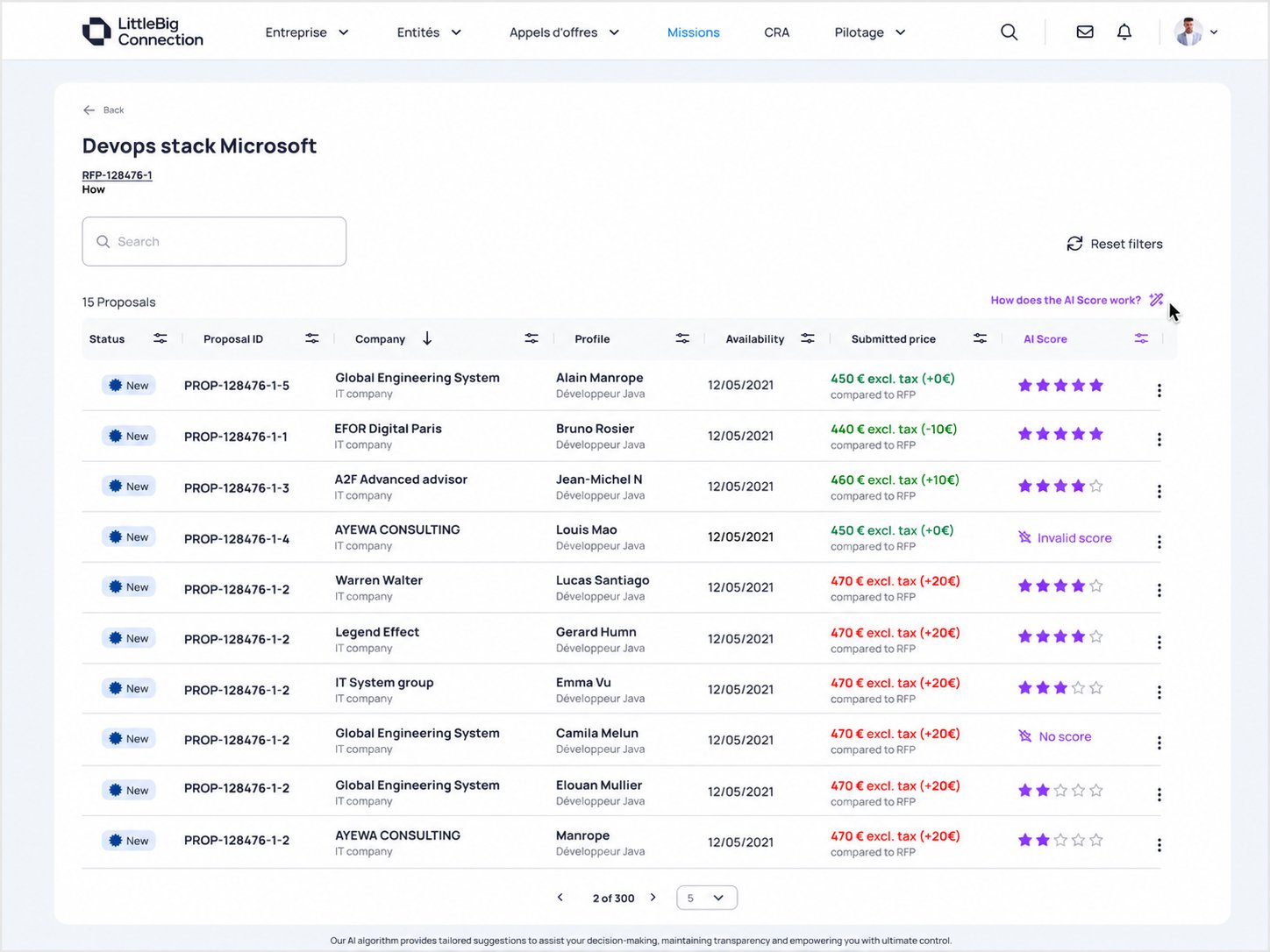
The shipped interface.
Each screen had a specific job. The UI is the evidence of the decisions above — not the story itself.
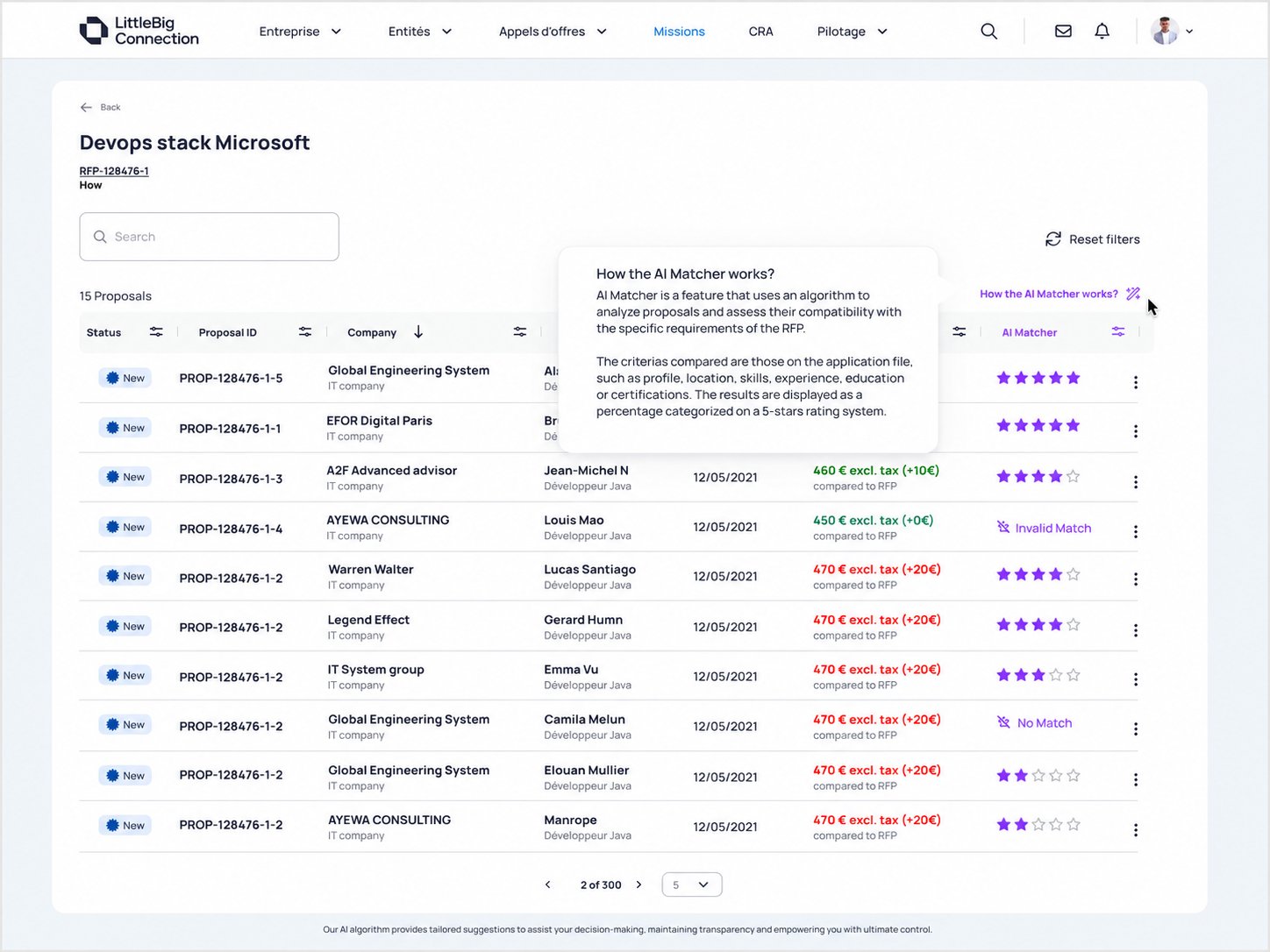
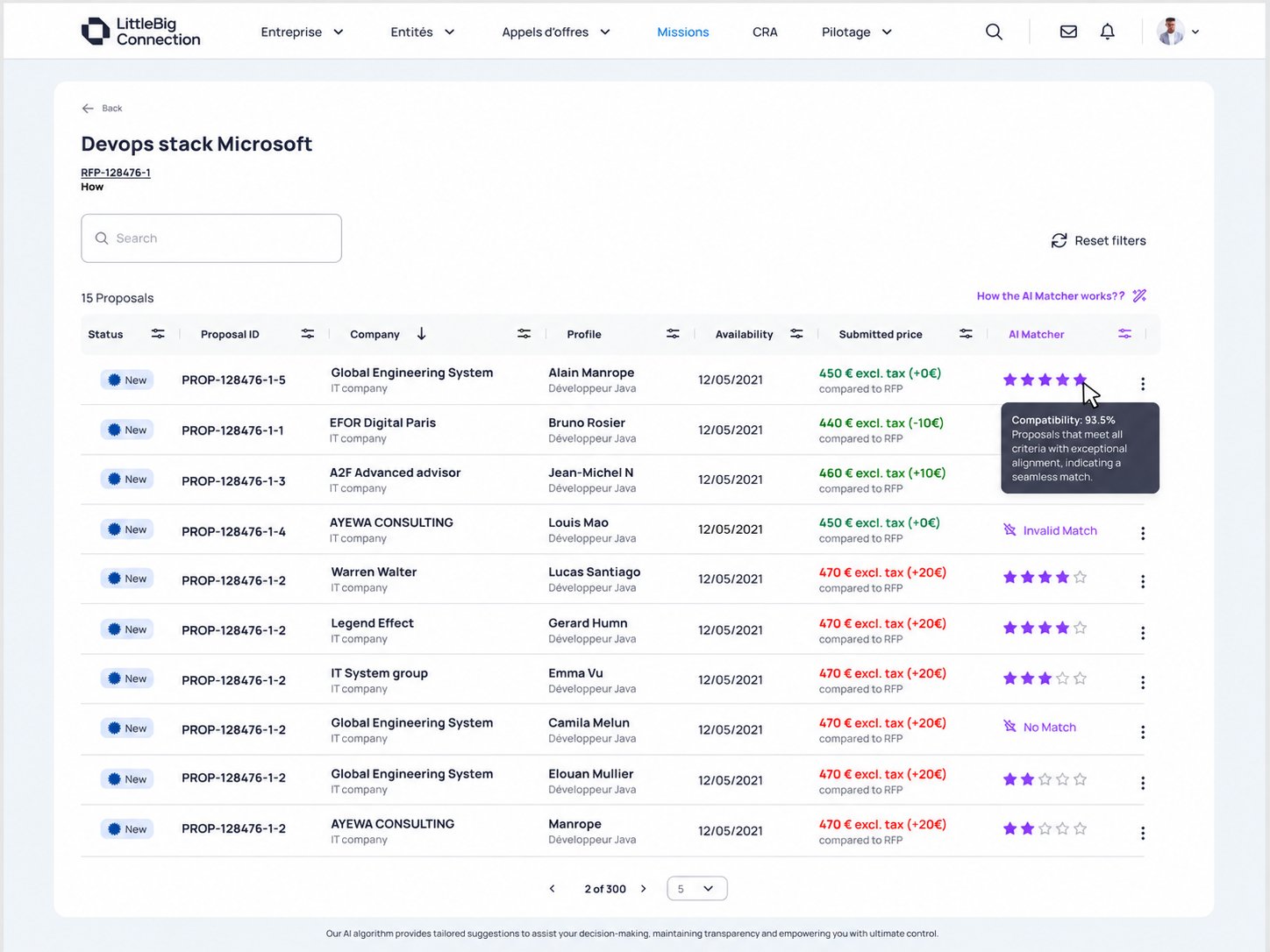
The hardest problem wasn't showing a score. It was designing for trust.
A score without context creates two failure modes: users ignore it, or users over-rely on it. Neither is acceptable when a missed candidate has real business consequences.
I translated ambiguous AI output into a scannable decision signal. I helped AMs prioritize attention, not automate judgement.
What was in. What was out. And why that mattered.
- AI proposal ranking by compatibility score
- CV parsing for text-based CVs (PDF, Word)
- Matching against RFP skills, title and description
- Proposal list AI Matcher column
- Star-based score (5-star system)
- Numeric compatibility score on proposal detail
- Explanation tooltip and popover
- Invalid Match and No Match states
- Angular migration of consultant profile pages
- Freelancer CV upload capability
- Structured profile data foundation for future AI
- Image-based CV parsing
- Automatic candidate selection
- Automatic candidate rejection
- Advanced recommendation engine
- Custom AM weighting of criteria
- Semantic search
- Full supplier-side optimization
- Large-scale matching algorithm
- Score breakdown per criterion
- AI-generated proposal summaries
Three iterations. One clear direction.
- Backend CV parsing logic
- AI matching algorithm
- Proposal list AI Matcher column
- Proposal detail numeric score
- Explanation tooltip and popup
- Angular migration for consultant profiles
- Freelancer CV upload
- Notify when profile lacks a CV
- Guided flow to upload CV
- No blocking of proposal submission
- Better supplier profile quality over time
- Custom AM weighting of criteria
- Suggestion-based proposal workflows
- Larger-scale matching algorithms
- Reusable profile data repository
The intended business outcomes.
These KPIs represent the intended business outcomes based on project goals, research findings and validated hypotheses. They should be treated as illustrative targets rather than audited production results. The PRD estimated a satisfaction improvement of 5–15% after introducing proposal screening support.